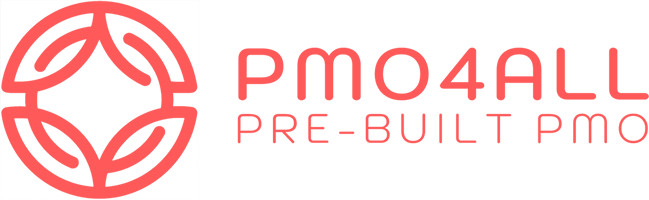


Agile Management methodologies, particularly Scrum, are vital for effective project management in today’s fast-paced business landscape. Scrum promotes flexibility, collaboration, and customer satisfaction through its structured roles, time-boxed sprints, and regular feedback loops, which enhance transparency and adaptability. Other methodologies like Kanban, Lean, and Extreme Programming (XP) provide tailored approaches for various project needs, focusing on visual workflow management, waste reduction, and technical excellence, respectively. Selecting the appropriate methodology hinges on project complexity, team dynamics, and organizational objectives, and utilizing pre-built methodologies from PMO4ALL can streamline the project management process.
In today’s fast-paced business environment, Agile Management methodologies like Scrum have become essential for effective project management. These methodologies not only enhance team collaboration but also ensure timely delivery of projects. By understanding and implementing Agile practices, organizations can adapt to changes swiftly and efficiently. In this article, we will explore the top Agile Management methodologies, focusing on Scrum, and compare them to help you choose the best approach for your projects.
Understanding Agile Management

Agile Management is a project management approach that emphasizes flexibility, collaboration, and customer satisfaction.
Unlike traditional methodologies that follow a linear and sequential process, Agile Management is iterative and incremental. This means that projects are broken down into smaller, manageable parts called iterations or sprints, allowing teams to deliver functional components of the project at regular intervals.
One of the core principles of Agile Management is the ability to adapt to changes quickly. In a dynamic business environment, requirements can evolve, and Agile methodologies provide the framework to accommodate these changes without derailing the entire project. This adaptability is achieved through continuous feedback loops, where stakeholders review and provide feedback on each iteration, ensuring that the project remains aligned with business goals.
Collaboration is another cornerstone of Agile Management. Cross-functional teams work together closely, often in daily stand-up meetings, to discuss progress, identify obstacles, and plan the next steps. This collaborative environment fosters transparency and accountability, as team members are aware of each other’s tasks and challenges.
Customer Satisfaction
is paramount in Agile Management. By involving customers and stakeholders throughout the project lifecycle, Agile methodologies ensure that the final product meets or exceeds expectations. Regular demonstrations of completed work, known as sprint reviews, provide opportunities for stakeholders to see progress and suggest adjustments, leading to a product that truly aligns with user needs.
Agile Management also promotes continuous improvement through retrospectives. After each iteration, teams reflect on what went well, what didn’t, and how processes can be improved. This culture of continuous learning and adaptation helps teams become more efficient and effective over time.
In summary, Agile Management is a flexible, collaborative, and customer-focused approach to project management. By breaking projects into smaller iterations, fostering close collaboration, and continuously seeking feedback, Agile methodologies like Scrum enable organizations to deliver high-quality products that meet evolving business needs.
Scrum: The Popular Choice
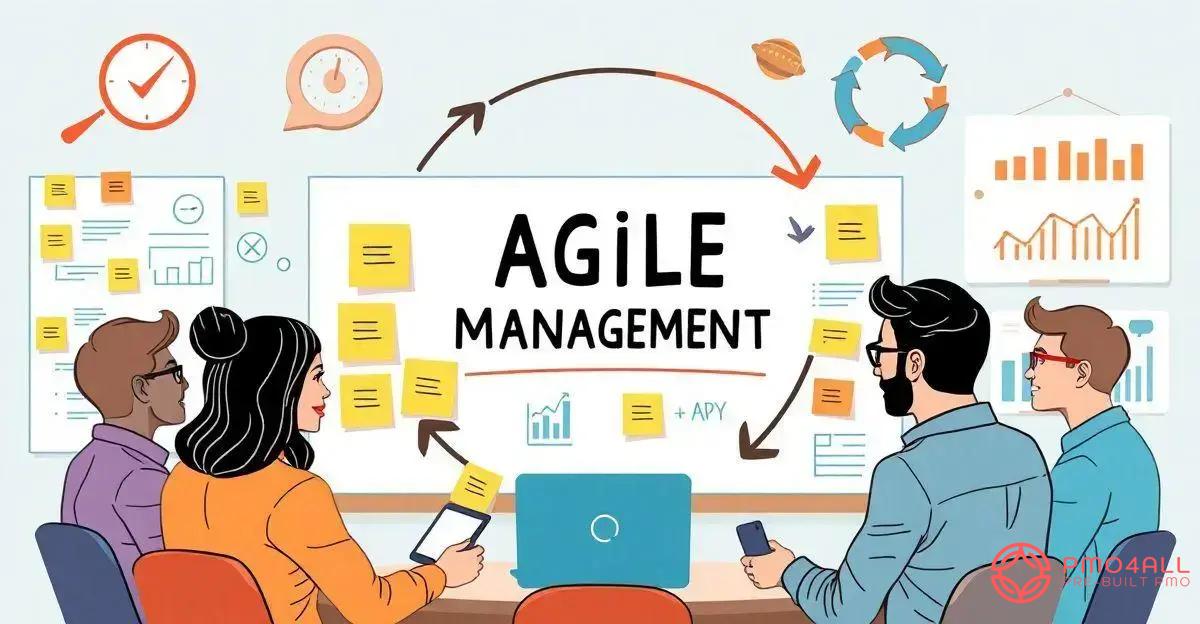
Scrum is one of the most widely adopted Agile Management methodologies, known for its simplicity and effectiveness in managing complex projects. Originating from the principles of Agile, Scrum provides a structured yet flexible framework that helps teams deliver high-quality products in a timely manner.
At the heart of Scrum are its roles, events, and artifacts. The primary roles include the Scrum Master, Product Owner, and Development Team. The Scrum Master acts as a facilitator, ensuring that the team adheres to Scrum practices and removing any impediments that may hinder progress. The Product Owner represents the stakeholders and is responsible for defining and prioritizing the product backlog, which is a dynamic list of features, enhancements, and bug fixes. The Development Team, a cross-functional group of professionals, is tasked with delivering potentially shippable increments of the product during each sprint.
Scrum operates on a series of time-boxed iterations called sprints, typically lasting two to four weeks. Each sprint begins with a Sprint Planning meeting, where the team selects items from the product backlog to work on and defines a sprint goal. Daily stand-up meetings, or Daily Scrums, are held to discuss progress, identify any obstacles, and plan the day’s work. At the end of the sprint, a Sprint Review is conducted to showcase the completed work to stakeholders, followed by a Sprint Retrospective where the team reflects on the sprint and identifies areas for improvement.
One of the key strengths of Scrum is its emphasis on transparency, inspection, and adaptation. By holding regular reviews and retrospectives, Scrum ensures that the team remains aligned with project goals and can make necessary adjustments based on feedback. This iterative process not only enhances product quality but also allows for continuous improvement in team performance.
Scrum’s popularity can be attributed to its ability to handle changing requirements effectively. In a fast-paced business environment, project requirements can evolve rapidly, and Scrum’s iterative approach provides the flexibility to incorporate these changes without significant disruptions. This adaptability makes Scrum particularly suitable for projects with high uncertainty or rapidly changing market conditions.
In conclusion, Scrum stands out as a popular choice among Agile Management methodologies due to its structured framework, emphasis on collaboration, and ability to adapt to changing requirements. By implementing Scrum, organizations can achieve greater efficiency, higher product quality, and improved stakeholder satisfaction.
Comparing Agile Methodologies
Agile Management encompasses various methodologies, each with its unique approach and benefits. While Scrum is one of the most popular, other methodologies like Kanban, Lean, and Extreme Programming (XP) also offer valuable frameworks for managing projects. Understanding the differences and similarities among these methodologies can help organizations choose the most suitable approach for their specific needs.
Scrum, as previously discussed, is characterized by its structured roles, time-boxed sprints, and iterative process. It is particularly effective for projects with well-defined deliverables and a need for regular stakeholder feedback. The emphasis on roles such as the Scrum Master and Product Owner ensures clear accountability and streamlined communication within the team.
Kanban, on the other hand, focuses on visualizing the workflow and limiting work in progress (WIP) to improve efficiency. Unlike Scrum, Kanban does not prescribe specific roles or time-boxed iterations. Instead, it uses a Kanban board to represent the stages of the workflow, allowing teams to manage tasks dynamically. This flexibility makes Kanban suitable for projects with continuous delivery needs and where priorities can change frequently.
Lean methodology aims to maximize value by eliminating waste and optimizing processes. Originating from manufacturing, Lean principles can be applied to software development and other industries. Lean focuses on delivering value to the customer, improving flow, and continuously enhancing processes. It is ideal for organizations looking to streamline operations and reduce inefficiencies.
Extreme Programming (XP) emphasizes technical excellence and customer satisfaction through practices like pair programming, test-driven development (TDD), and continuous integration. XP encourages frequent releases in short development cycles, enhancing the ability to respond to changing requirements. This methodology is particularly beneficial for projects requiring high-quality code and rapid adaptation to user feedback.
Comparing Agile Methodologies
While these methodologies share common Agile principles such as collaboration, flexibility, and customer focus, they differ in their implementation and specific practices. Scrum’s structured approach with defined roles and sprints contrasts with Kanban’s flexible, visual workflow management. Lean’s focus on waste reduction and process optimization offers a broader perspective on efficiency, while XP’s technical practices ensure high-quality software development.
Choosing the right Agile methodology depends on various factors, including project complexity, team dynamics, and organizational goals. For instance, a software development team aiming for rapid, high-quality releases might benefit from XP, while a team managing a continuous flow of tasks could find Kanban more suitable. Scrum’s structured framework may be ideal for projects requiring regular stakeholder engagement and clear accountability.
In conclusion, comparing Agile methodologies reveals that each has its strengths and is suited to different project environments. By understanding the unique features and benefits of Scrum, Kanban, Lean, and XP, organizations can make informed decisions and implement the most effective Agile practices for their projects.
In the realm of project management, Agile methodologies like Scrum have revolutionized the way teams operate, fostering greater flexibility, collaboration, and customer satisfaction. By understanding the fundamental principles of Agile Management, organizations can better adapt to the dynamic business environment and deliver high-quality products efficiently.
Scrum, with its structured roles, time-boxed sprints, and iterative process, stands out as a popular choice for managing complex projects. Its emphasis on transparency, inspection, and adaptation ensures that teams remain aligned with project goals and can respond swiftly to changing requirements. The collaborative nature of Scrum, coupled with regular feedback loops, enhances both team performance and stakeholder satisfaction.
Other Agile Methodologies
However, Scrum is not the only Agile methodology available. Kanban, Lean, and Extreme Programming (XP) each offer unique approaches that cater to different project needs. Kanban’s visual workflow management and flexibility make it ideal for continuous delivery projects, while Lean’s focus on waste reduction and process optimization provides a broader perspective on efficiency. XP’s technical practices ensure high-quality software development and rapid adaptation to user feedback.
Ultimately, the choice of Agile methodology depends on various factors, including project complexity, team dynamics, and organizational goals. By comparing and understanding the strengths of Scrum, Kanban, Lean, and XP, organizations can select the most suitable approach to achieve their project objectives.
Wouldn’t it be more efficient to implement a proven, ready-to-use methodology that’s already available in several languages, rather than building one from scratch? By leveraging pre-built methodologies from PMO4ALL, organizations can save time, effort, and resources, ensuring a smoother and more effective project management experience. Explore the comprehensive solutions offered by PMO4ALL and take the first step towards transforming your project management practices.
Frequently Asked Questions about Agile Management Methodologies
What is Agile Management?
Agile Management is a project management approach that emphasizes flexibility, collaboration, and customer satisfaction. It involves iterative and incremental processes, allowing teams to deliver functional components of a project at regular intervals.
Why is Scrum a popular Agile methodology?
Scrum is popular due to its structured framework, which includes defined roles, time-boxed sprints, and regular feedback loops. This structure enhances transparency, collaboration, and adaptability, making it effective for managing complex projects.
How does Kanban differ from Scrum?
Kanban focuses on visualizing the workflow and limiting work in progress (WIP) to improve efficiency. Unlike Scrum, it does not prescribe specific roles or time-boxed iterations, making it more flexible for projects with continuous delivery needs.
What are the key principles of Lean methodology?
Lean methodology aims to maximize value by eliminating waste and optimizing processes. It focuses on delivering value to the customer, improving flow, and continuously enhancing processes, making it ideal for organizations looking to streamline operations.
What practices are emphasized in Extreme Programming (XP)?
Extreme Programming (XP) emphasizes technical excellence and customer satisfaction through practices like pair programming, test-driven development (TDD), and continuous integration. These practices ensure high-quality software development and rapid adaptation to user feedback.
How can organizations choose the right Agile methodology?
Choosing the right Agile methodology depends on factors such as project complexity, team dynamics, and organizational goals. By comparing the strengths of Scrum, Kanban, Lean, and XP, organizations can select the most suitable approach to achieve their project objectives.





Leave A Comment